
Where to install Power Distribution Unit : Location, Orientation, and Rack Compatibility

In data centers, industrial control cabinets, and network environments, power distribution units (PDUs) play a critical role in managing and delivering reliable power to equipment. The efficiency, safety, and accessibility of electrical power depend not only on the PDU’s specifications but also on where and how it is installed. Choosing the right installation location and orientation ensures optimal space utilization, better cable management, and long-term operational reliability.
Where to Install Power Distribution Units
PDUs are typically installed inside equipment racks or cabinets, where they distribute electrical power to servers, switches, storage devices, or industrial network components. The installation location should be determined according to the cabinet design, equipment layout, and power routing strategy. In general, PDUs are mounted either vertically along the rack frame (often referred to as “0U” or “1U vertical” installation), or horizontally within the equipment mounting space (1U or 2U horizontal). Each method has its advantages, and the choice depends on the rack size, power requirements, and space allocation for IT or industrial devices.
A PDU should always be installed in a position that ensures safe power connection, adequate airflow, and easy accessibility for maintenance. For example, in dense data center environments, PDUs are often placed at the rear of the rack, allowing power cords to be neatly routed without blocking ventilation. In industrial cabinets, PDUs may be installed on the side panel or at the bottom to fit specialized equipment layouts and wiring needs.
Vertical Installation: 0U and 1U Vertical Mounting
Vertical installation is one of the most common configurations, particularly in tall server or network racks.
-
0U Vertical Installation
A “0U” PDU is designed to be mounted vertically on the side of a rack without occupying any of the rack’s unit (U) space reserved for equipment. This approach maximizes usable rack space and provides a clean, organized layout. Vertical PDUs are ideal for high-density environments where every unit of rack space is valuable. They typically run along the rear or side of the rack and feature multiple outlets aligned vertically to match equipment power inputs.
-
1U Vertical Installation
Some cabinets, especially industrial or compact network enclosures, may not support full-length 0U PDUs. In such cases, a 1U vertical PDU provides a shorter alternative that can still be installed along the cabinet’s side panel. This configuration maintains vertical power distribution while fitting into smaller spaces, offering flexibility in design and maintenance.
Vertical PDUs are often preferred for their efficient space utilization, convenient cable routing, and better airflow management. However, they require racks that have sufficient side space and mounting brackets designed for vertical installation.
Horizontal Installation: 1U and 2U Mounting
Horizontal installation refers to mounting the PDU within the standard equipment space of the rack, typically occupying 1U or 2U of vertical rack height.
-
1U Horizontal Installation
A 1U horizontal PDU is mounted in the same way as other rack equipment, such as switches or servers. This configuration provides direct front or rear access to the power outlets and is convenient for small systems or edge applications where equipment density is lower. It also allows for straightforward monitoring if the PDU includes a display or network interface on its front panel.
-
2U Horizontal Installation
When more outlets or advanced power management features are required, a 2U horizontal PDU may be used. The additional height provides more room for sockets, circuit breakers, and communication modules, making it suitable for larger power capacities.
Horizontal PDUs are ideal when rack space is not a major limitation or when equipment layout requires the power distribution to be centralized and easily visible. However, because they occupy usable rack units, they are less suitable for environments with limited rack height or dense device configurations.
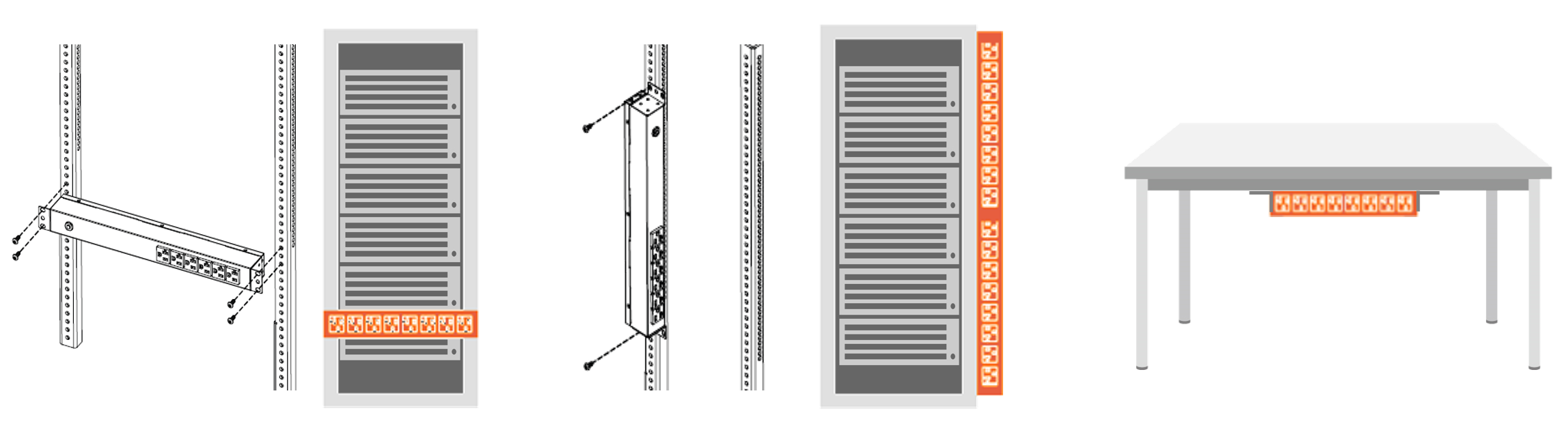
Choosing the Right Form Factor: Rack Size and Installation Position
For tall, full-size racks in data centers or telecom environments, 0U vertical PDUs are generally the best choice, providing maximum outlet density without consuming rack space. For medium-sized cabinets or industrial enclosures, 1U vertical or 1U horizontal installations may offer the best balance between space and accessibility. In cases where additional functionality is required—such as surge protection, metering, or remote monitoring—a 2U horizontal PDU can provide the extra room needed to accommodate these components.
Additionally, environmental conditions such as airflow direction, temperature, and cable access points should influence the installation decision. A well-planned PDU placement enhances cooling efficiency, reduces clutter, and minimizes the risk of accidental cable disconnection.
Conclusion
The installation of a power distribution unit is more than a mechanical or electrical consideration—it is a critical aspect of system design that affects power reliability, safety, and operational convenience. PDUs can be installed vertically or horizontally in a rack, with common configurations including 0U vertical, 1U vertical, 1U horizontal, and 2U horizontal. When determining the most suitable form factor, engineers should always start by assessing the cabinet size and the intended installation location. An optimal installation ensures that power is delivered efficiently, maintenance is simplified, and valuable rack space is utilized effectively.
At Emplus, we understand that every installation environment has unique demands. Our industrial-grade PDUs are designed for flexible mounting options, robust electrical protection, and seamless integration into diverse rack systems. By combining practical design with engineering reliability, Emplus helps customers build power distribution solutions that support long-term performance, scalability, and safety across industrial and networking applications.