
Fast Initial Link Setup (FILS): Speeding Up Secure WLAN Access

In today’s digital age, users expect instant and seamless connectivity, especially when using wireless local area networks (WLANs). As the number of mobile and IoT devices continues to rise, the demand for faster and more efficient wireless connectivity has become more pressing. Traditional Wi-Fi connection procedures, though secure, often suffer from noticeable delays during the initial link setup. To address this issue, the IEEE introduced a solution in the form of the Fast Initial Link Setup (FILS) protocol, defined under the IEEE 802.11ai specification. FILS is designed to reduce connection delays without compromising the security and integrity of the authentication process.
Background and Motivation
In standard Wi-Fi networks, the process of connecting to an access point (AP) includes multiple steps: scanning, authentication, association, and key exchange. Each of these steps involves exchanging packets, which leads to noticeable delays, particularly in dense environments such as airports, train stations, or stadiums. These delays are especially problematic for mobile devices that frequently transition between APs and for applications requiring low latency, such as voice over IP (VoIP) or video streaming.
Recognizing these challenges, the IEEE 802.11ai task group proposed FILS, a mechanism that reduces the time it takes for a device (station or STA) to securely connect to a Wi-Fi network. FILS enables faster network access—within 100 milliseconds—making it especially beneficial for highly mobile clients and time-sensitive applications.
How FILS Works
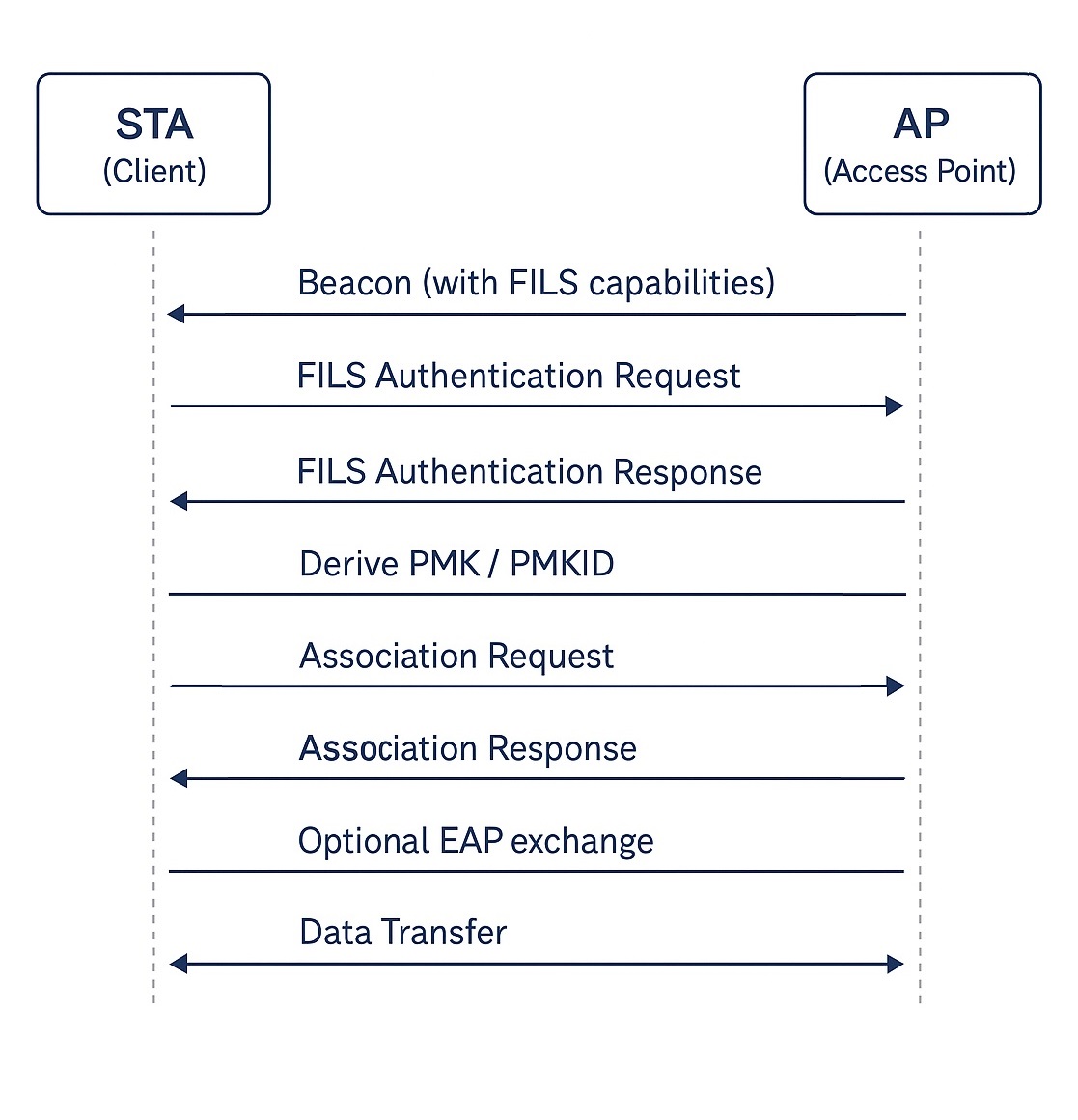
The main innovation behind FILS is its ability to streamline the authentication and association process. FILS enables a station to quickly discover, authenticate with, and associate to a wireless network through a consolidated set of messages. This contrasts with the traditional multi-step Extensible Authentication Protocol (EAP) exchanges that occur sequentially and can take hundreds of milliseconds.
FILS supports EAP-RP (EAP Re-authentication Protocol) for secure authentication and key derivation. During the initial connection, the STA and the AP perform a full EAP exchange using FILS messages, which results in the establishment of a Pairwise Master Key (PMK). Once this key is derived, it can be cached and reused for future connections to the same or neighboring APs that support PMK caching, significantly reducing the setup time in subsequent connections.
Key Features of FILS
-
Fast Authentication and Association
FILS merges several steps of the traditional connection process into fewer messages. This bundling allows for quicker establishment of secure connections without sacrificing security.
-
Support for EAP
By incorporating EAP within its framework, FILS ensures that all authentication mechanisms supported by EAP (e.g., EAP-TLS, EAP-TTLS, EAP-PEAP) can be used, maintaining compatibility with existing security infrastructures.
-
Key Derivation and Caching
FILS supports key caching mechanisms such as PMK caching and Opportunistic Key Caching (OKC), which further reduce delay when reconnecting to an AP.
-
Scalability in Dense Environments
FILS is particularly beneficial in areas with a high concentration of users and APs. It minimizes the authentication overhead and helps avoid network congestion.
-
Robust Security
Despite the emphasis on speed, FILS does not compromise on security. The use of strong encryption and secure key exchange methods ensures that user data remains protected.
Use Cases and Benefits
FILS is especially useful in scenarios where devices are highly mobile or frequently transitioning between access points. Some notable use cases include:
-
Transportation Hubs
In airports and train stations, where passengers often move rapidly between APs, FILS enables fast and secure handoffs.
-
Smart Cities and IoT
With many sensors and smart devices requiring periodic connections to the network, FILS reduces power consumption and connection latency.
-
Enterprise Environments
In large office spaces with multiple APs, FILS enhances the user experience by reducing wait times when roaming.
-
Public Wi-Fi
In densely populated areas with high wireless traffic, FILS can alleviate congestion and speed up access for end users.
Challenges and Adoption
While FILS offers significant advantages, its adoption has been gradual. One reason is that both the AP and the client device must support the FILS protocol. Upgrading infrastructure to include 802.11ai support may require time and investment. Additionally, integration with existing security systems must be carefully managed to ensure compatibility.
However, as more manufacturers include FILS support in their wireless chipsets and as demand for low-latency connectivity increases, the adoption rate is expected to grow. It is anticipated that FILS will play a crucial role in next-generation wireless networks, especially when integrated with Wi-Fi 6 and future Wi-Fi 7 deployments.
Conclusion
The Fast Initial Link Setup (FILS) protocol represents a significant leap forward in the evolution of wireless networking. By dramatically reducing the time required to establish a secure connection, FILS enhances the user experience in a wide variety of environments. Through the use of EAP-RP for authentication and efficient key derivation, FILS maintains strong security while improving connection speed and efficiency. As WLAN technology continues to evolve to meet modern demands, FILS is poised to become a standard feature in high-performance, low-latency wireless networks. Companies like Emplus, which specialize in advanced wireless solutions, are integrating FILS support into their products to meet the growing demand for faster and more seamless connectivity in smart cities, industrial applications, and enterprise environments.