
Driving Industrial Digitalization with Modbus TCP

As factories evolve toward digitalization and intelligent automation, communication protocols play a crucial role in ensuring interoperability and efficient data exchange. Among these technologies, Modbus TCP has emerged as one of the most widely adopted industrial communication protocols due to its simplicity, openness, and compatibility with Ethernet-based networks. Originally derived from the serial Modbus protocol developed in the late 1970s, Modbus TCP extends these capabilities into the IP world, providing a robust and flexible method for connecting industrial equipment across local or remote networks.
Fundamentals of Modbus TCP
Modbus TCP—also known as Modbus TCP/IP—is a communication protocol that combines the traditional Modbus application layer with the TCP/IP transport layer. It uses standard Ethernet infrastructure and the TCP protocol to ensure reliable, connection-oriented communication. Data is transmitted through TCP Port 502, allowing industrial devices such as PLCs, HMIs, sensors, gateways, and SCADA systems to communicate over existing IP networks without specialized wiring.
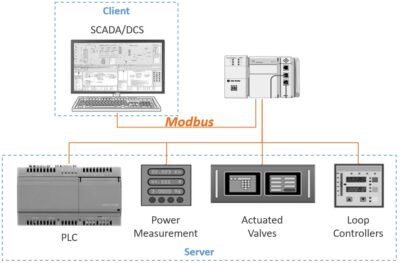
The Modbus protocol operates through a simple request–response mechanism. A client device sends a query to a server, which processes the request and returns the necessary information or executes the given command. Four main data types—coils, discrete inputs, holding registers, and input registers—allow Modbus TCP to represent digital and analog values consistently across devices. This structured and predictable format makes Modbus TCP easy to integrate into a wide range of automation systems. Because Modbus TCP is based on Ethernet, it supports significantly higher bandwidth compared to serial Modbus RTU. It also benefits from standard Ethernet features such as switching, routing, VLAN segmentation, QoS, and redundancy protocols. These enhancements improve throughput, scalability, and reliability, allowing Modbus TCP networks to operate efficiently in both small-scale and large distributed industrial environments.
Advantages of Modbus TCP in Industrial Networking
One of the primary advantages of Modbus TCP is its open and royalty-free nature. Manufacturers can implement the protocol without licensing fees, which has contributed to its widespread adoption across different product categories and industries. This openness ensures that equipment from different suppliers can interoperate easily, reducing integration costs and enabling flexible system expansion.
Another significant benefit is Modbus TCP’s compatibility with standard Ethernet infrastructure. Because it uses TCP/IP, the protocol can travel across commercially available switches, routers, and firewalls. This reduces deployment complexity and eliminates the need for proprietary cabling or specialized converters. In modern factories transitioning to Industrial Ethernet, Modbus TCP offers a simple bridge between legacy Modbus devices and contemporary networked architectures.
Additionally, Modbus TCP provides enhanced speed and scalability. Ethernet networks can deliver much higher throughput than RS-485 serial lines, enabling real-time or near-real-time monitoring of equipment. The protocol also supports multiple simultaneous client connections, which is essential for SCADA systems, historians, maintenance dashboards, and cloud-based analytics platforms. As industrial environments increasingly rely on centralized data and predictive maintenance systems, Modbus TCP offers the performance headroom necessary to support these applications. From a security perspective, Modbus TCP can be protected using common IT cybersecurity practices, such as network segmentation, VPNs, firewalls, and intrusion detection systems. Although the original protocol itself does not include encryption or authentication, its reliance on IP networking allows users to implement modern security controls around their industrial control systems.
Applications of Modbus TCP in Industry
Modbus TCP is found in virtually every industrial sector, from manufacturing and energy to transportation and building automation. In production environments, PLCs frequently use Modbus TCP to exchange real-time data with motor drives, servo controllers, temperature sensors, and vision systems. Because many vendors support Modbus as a standard feature, it is often the simplest choice for integrating third-party equipment into an existing system.
In energy and utility applications, Modbus TCP plays a key role in monitoring power meters, solar inverters, battery management systems, and substation automation devices. The protocol’s reliability and compatibility with SCADA platforms make it ideal for long-term operational monitoring and remote control.
Building automation also benefits from Modbus TCP. HVAC controllers, lighting systems, access control devices, and fire safety systems often rely on Modbus to share status information with centralized management systems. With Ethernet infrastructure already present in most commercial buildings, Modbus TCP enables easy integration without additional hardware investment.
In emerging smart manufacturing applications, Modbus TCP serves as a bridge between traditional industrial equipment and modern cloud or edge platforms. Gateways can collect Modbus data from factory machinery and transmit it to AI engines, digital twins, or predictive maintenance algorithms. This positions Modbus TCP as a key enabler in the evolution toward Industry 4.0 and smart factories.
Conclusion
Modbus TCP remains one of the most practical and versatile communication protocols in industrial networking. By combining the familiarity of Modbus with the speed and flexibility of Ethernet, it provides a reliable channel for data exchange across a wide range of applications. Its openness, simplicity, and scalability make it an excellent choice for both legacy modernization and next-generation smart manufacturing systems. As industries continue to adopt digital technologies and connected architectures, Modbus TCP will remain a foundational protocol, supporting interoperability, efficient data flow, and seamless integration across diverse industrial environments.