
How Ring Redundancy Minimizes Network Downtime in Industrial Environments

Network reliability in industrial environments is no longer a “nice to have”—it is a core requirement. Manufacturing lines, automated warehouses, transportation systems, and critical infrastructure all depend on continuous, real-time data exchange. When a network interruption occurs, even for a fraction of a second, the impact can be significant: halted production, data loss, safety risks, and costly downtime. This is why, in industrial networking, milliseconds truly matter.
One of the most effective technologies for ensuring high availability and fast recovery in industrial Ethernet networks is ring redundancy. Designed to maintain connectivity even when a link or device fails, ring redundancy plays a vital role in minimizing downtime and keeping industrial operations running smoothly.
The High Cost of Network Downtime in Industry
Industrial networks operate under very different conditions compared to typical office IT environments. They often support time-critical applications such as motion control, PLC communication, SCADA systems, and machine vision. These applications require deterministic communication, predictable latency, and rapid fault recovery.
A single network failure—caused by a damaged cable, power interruption, or hardware malfunction—can stop an entire production line. Unlike IT networks, where recovery times of several seconds may be acceptable, industrial networks often require recovery times measured in milliseconds. Any delay beyond this threshold can trigger system faults, safety shutdowns, or production losses.
This is where redundancy mechanisms become essential rather than optional.
Understanding Ring Topology in Industrial Ethernet
Ring topology is a common network design in industrial environments. In a ring, each switch or device is connected to two neighboring devices, forming a closed loop. Under normal conditions, data flows in a predefined direction, and one link is logically blocked to prevent network loops.
The real advantage of a ring topology becomes apparent when a failure occurs. If a cable is cut or a switch goes offline, the ring is broken—but communication does not stop. Instead, redundancy protocols quickly detect the failure and reconfigure the network so that traffic is rerouted in the opposite direction around the ring.
This automatic recovery ensures continuous communication without requiring manual intervention, a critical capability in harsh and remote industrial settings.
How Ring Redundancy Achieves Millisecond-Level Recovery
Ring redundancy protocols are specifically optimized for fast failure detection and recovery. Industrial switches continuously monitor link status and exchange control messages with neighboring devices. When a failure is detected, the network immediately recalculates the data path and unblocks the previously blocked link.
Modern industrial ring redundancy mechanisms can achieve recovery times well below one second, and in many cases, within a few milliseconds. This speed is crucial for applications that cannot tolerate communication gaps, such as synchronized motion systems or real-time control networks.
Compared to traditional spanning tree protocols used in enterprise networks, industrial ring redundancy solutions are significantly faster and more deterministic, making them better suited for mission-critical environments.
Reliability in Harsh and Dynamic Environments
Industrial networks are often deployed in harsh conditions—exposed to vibration, electrical noise, extreme temperatures, and physical wear. These factors increase the likelihood of cable damage or intermittent connection issues.
Ring redundancy adds a layer of resilience by ensuring that a single point of failure does not bring down the entire network. Even in mobile or dynamic environments, such as automated warehouses or transportation systems, ring-based redundancy helps maintain stable communication despite frequent movement and mechanical stress.
In addition, ring topology simplifies network design and troubleshooting. The structured layout makes it easier to isolate faults and maintain consistent performance across the network.
Enabling Scalable and Future-Proof Industrial Networks
As industrial environments continue to evolve, networks must scale to support more devices, higher bandwidth, and advanced applications such as AI-based inspection and edge computing. Ring redundancy supports this growth by providing a stable foundation that can expand without compromising reliability.
By combining redundancy with industrial-grade hardware, organizations can build networks that not only meet today’s requirements but are also prepared for future demands. High availability becomes a built-in feature rather than an afterthought.
Emplus Industrial Switch Solutions Powered by emRing Redundancy
At the core of Emplus industrial Ethernet switches is emRing, Emplus’s proprietary ring redundancy technology designed specifically for industrial environments where fast recovery and stable communication are critical.
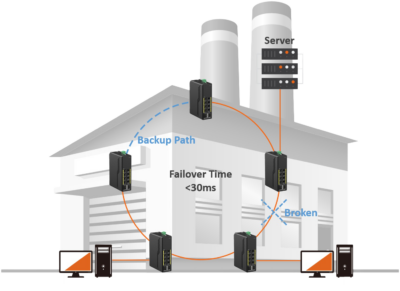
emRing continuously monitors network links and switch status, enabling rapid fault detection and automatic traffic rerouting in the event of a link or device failure. With millisecond-level recovery performance, emRing helps ensure uninterrupted communication for time-sensitive industrial applications such as automation control, SCADA systems, and smart manufacturing networks.
Emplus integrates emRing across its three industrial switch series to address different deployment needs:
- Premium Series: Built for mission-critical systems, the Premium series fully leverages emRing with advanced management and high-performance hardware, delivering ultra-fast recovery and maximum network availability for demanding industrial applications.
- Smart Series: The Smart series brings emRing redundancy to managed industrial networks that require reliability, flexibility, and cost efficiency. It is well-suited for scalable factory and infrastructure deployments where fast failover is essential.
- Unmanaged Series: Even in simplified network architectures, selected Unmanaged models support emRing-based ring redundancy, offering plug-and-play resilience without configuration complexity—ideal for straightforward industrial installations.
By standardizing emRing across its industrial switch portfolio, Emplus enables users to build resilient, self-healing networks that minimize downtime and protect critical operations—because in industrial environments, every millisecond counts.