
How SASE is Redefining Enterprise Network Security in the Cloud Era

As the modern enterprise rapidly shifts toward a hybrid and cloud-native infrastructure, traditional network and security architectures are proving insufficient. The increasing demand for remote work, SaaS adoption, edge computing, and mobile access has made it clear: perimeter-based security is no longer adequate. This is where Secure Access Service Edge (SASE) comes in. SASE is more than just a buzzword—it represents a strategic convergence of networking and security in a cloud-delivered model, enabling organizations to manage user access, enforce policies, and ensure data protection regardless of user location or device.
What is SASE?
First introduced by Gartner in 2019, SASE (Secure Access Service Edge) combines wide area networking (WAN) with network security services, delivered from a unified cloud-based platform. Instead of securing a network perimeter, SASE shifts the focus to the identity of the user or device, dynamically applying security and access policies based on context, such as location, device status, and user behavior.
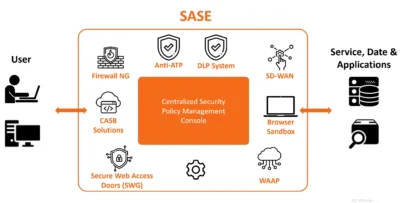 Core components of SASE include:
-
Software-Defined WAN (SD-WAN)
Optimizes routing and bandwidth across distributed environments.
-
Secure Web Gateway (SWG)
Protects users from malicious websites and content.
-
Cloud Access Security Broker (CASB):
Provides visibility and control over cloud service usage.
-
Firewall as a Service (FWaaS)
Delivers scalable firewall protection without physical appliances.
-
Zero Trust Network Access (ZTNA)
Enforces least-privilege access based on identity and context.
Together, these elements form a secure, flexible, and cloud-native approach to network management and cybersecurity.
Why Traditional Architectures Are No Longer Enough
Legacy security models rely on perimeter-based defenses—firewalls, VPNs, and intrusion prevention systems deployed at fixed locations. While this model worked in a data center-centric world, it fails to protect data that flows across multiple clouds, devices, and remote endpoints. Modern users connect from anywhere, often bypassing corporate networks entirely to access cloud apps like Microsoft 365, Zoom, or Salesforce. This creates visibility gaps and inconsistent security enforcement. SASE solves this problem by converging networking and security in the cloud, delivering policy enforcement closer to the user and the application—regardless of their physical location.
Key Benefits of SASE
-
Reduced Complexity
By consolidating multiple network and security functions into a unified cloud-native platform, SASE simplifies IT operations and reduces the number of vendors and hardware appliances required.
-
Improved Performance
With local breakouts, SASE routes traffic through the nearest cloud point of presence (PoP), reducing latency for users accessing cloud-based services like Microsoft 365, Salesforce, or AWS.
-
Enhanced Security
SASE applies consistent, identity-driven security policies across all endpoints, regardless of whether users are in the office, at home, or on the move. This is critical for enforcing Zero Trust principles.
-
Scalability and Flexibility
Cloud-delivered SASE architectures scale automatically with your business needs, removing the limitations of traditional on-prem infrastructure.
Zero Trust and SASE: A Powerful Combination
At the heart of SASE is the Zero Trust philosophy: never trust, always verify. Traditional security often grants broad access based on network location (e.g., inside the firewall = trusted). Zero Trust, by contrast, enforces granular, identity-based access controls, even for internal users.
SASE enables organizations to implement Zero Trust Network Access (ZTNA) on a global scale. Every connection request is evaluated in real time, and access is granted based on multiple factors—not just credentials, but also device posture, user behavior, and risk profile.
Real-World Applications
Organizations adopting SASE have reported gains in security visibility, incident response, and network agility. Common use cases include:
-
Securing remote workforces
Provide secure, policy-driven access without complex VPN infrastructure.
-
Cloud migration
Extend consistent security policies to IaaS and SaaS environments.
-
M&A integration
Quickly connect and secure new business units without hardware rollouts.
-
Edge connectivity
Enable secure access for IoT devices, smart buildings, and distributed sites.
Preparing for a SASE-Driven Future
The transformation to SASE is not just a security trend—it’s an evolution in enterprise network design. As applications, users, and data become more distributed, the need for cloud-native, identity-aware networking becomes essential. Emplus is committed to supporting this transition through robust, secure, and scalable network hardware solutions—designed for both modern enterprises and industrial environments. Whether you’re an IT leader preparing for digital transformation or an operations engineer modernizing factory connectivity, embracing SASE principles today lays the foundation for a secure, resilient network tomorrow.