
Wireless Signal Measurement Technology: Signaling and Non-Signaling Mode Testing

Wireless signal measurement technology plays a crucial role in the evaluation and optimization of communication systems. As wireless networks evolve to support higher data rates and increased device connectivity, ensuring robust signal quality is more important than ever. One of the key methodologies in wireless signal measurement involves testing in both signaling mode (User Mode) and non-signaling mode (Factory Test Mode, FTM). These two modes serve different purposes and are used in various testing environments to assess signal quality, performance, and reliability. Let’s explore the characteristics, advantages, and practical applications of signaling and non-signaling mode testing, emphasizing how they contribute to a more accurate representation of real-world user experience.
Signaling Mode (User Mode) Testing
Signaling mode testing, also known as User Mode testing, is conducted under real-world conditions where a device interacts with a live network. In this mode, the wireless device communicates with the network and exchanges signals as an actual user would. The main advantage of this method is its ability to simulate real user experiences and provide accurate signal quality assessments.
In signaling mode testing, the device must authenticate, synchronize, and exchange data with the network. This allows engineers to measure various critical performance metrics, including:
-
Signal Strength (RSSI, RSRP, RSRQ)
These parameters indicate how well a device receives signals from the network.
-
Throughput Performance
The real-world data rates a device can achieve under different network conditions.
-
Latency and Packet Loss
Key indicators of network responsiveness and stability.
-
Handovers and Roaming
Evaluates how smoothly a device transitions between different base stations or network types.
Non-Signaling Mode (Factory Test Mode, FTM) Testing
Non-signaling mode testing, or Factory Test Mode (FTM) testing, differs significantly from signaling mode testing in that it does not require network authentication or communication with a live network. Instead, this mode directly transmits and receives predefined test signals, bypassing network protocols and user interactions. This approach is primarily used in production line testing, research and development, and component-level validation.
Key characteristics of non-signaling mode testing include:
-
Controlled Testing Environment
Since there is no network interaction, the test conditions remain stable and reproducible, allowing for precise measurement of signal parameters.
-
Faster and More Efficient Testing
Without the need for network authentication, devices can be tested rapidly, making FTM an essential method for mass production and quality control.
-
Component-Level Diagnostics
Engineers can isolate specific radio frequency (RF) performance aspects without interference from network variables.
While non-signaling mode testing is useful for initial device validation, it does not fully reflect real-world network conditions and user experience, as the device does not undergo normal signal exchange procedures.
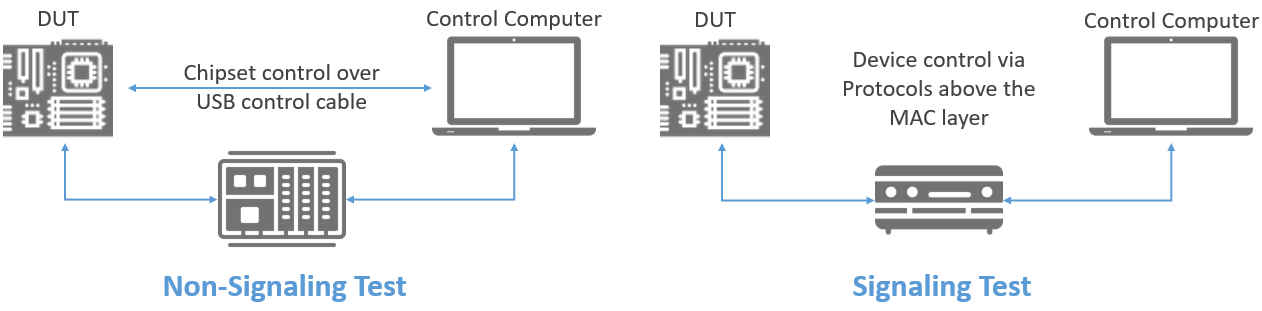
Comparing Signaling and Non-Signaling Mode Testing
Both signaling and non-signaling mode testing serve essential roles in wireless device evaluation, but their applications and advantages differ significantly. The table below summarizes their key differences:
| Feature | Signaling Mode (User Mode) | Non-Signaling Mode (FTM) |
| Network Interaction | Yes (Real network) | No (Standalone testing) |
| Testing Speed | Slower (Network authentication required) | Faster (Bypasses network) |
| Real-World Accuracy | High (Simulates actual user experience) | Lower (Does not account for network dynamics) |
| Use Case | Field testing, performance optimization, troubleshooting | Factory testing, hardware validation, R&D |
| Flexibility | Dependent on network conditions | Fully controlled test environment |
Advantages of Signaling Mode Testing for Real-World Applications
While both testing modes are essential, signaling mode testing provides a more accurate representation of real user experiences. The key advantages of signaling mode testing include:
-
More Realistic Performance Metrics
Since the device connects to an actual network, all external factors—such as interference, congestion, and environmental conditions—are accounted for.
-
Better Insight into User Experience
Operators can analyze real-world factors like handovers, data throughput fluctuations, and connection stability.
-
Essential for Network Optimization
Wireless carriers and device manufacturers rely on signaling mode testing to fine-tune network parameters and improve end-user connectivity.
-
Critical for Certification and Compliance
Many regulatory and certification processes require user-mode testing to ensure that devices function correctly in commercial network environments.
Wireless signal measurement is a fundamental aspect of network and device performance evaluation. Signaling mode (User Mode) and non-signaling mode (FTM) testing each serve distinct but complementary purposes. While non-signaling mode is invaluable for factory testing and initial validation, signaling mode provides a more accurate assessment of real-world user experience. By leveraging both testing methodologies, Emplus engineers ensure that wireless devices meet performance standards while delivering optimal network experiences to end users. As wireless technologies continue to advance, the integration of both testing approaches will remain critical in the development and deployment of next-generation communication systems.